Sunday, October 14, 2012

perfectly imperfect

A rose looks many different ways to many different people. 


Before the summer started, I imagined a season of love. I would be traveling with a dear friend who I loved deeply. We were going to get a chance to be together. And I thought that it was going to be perfect.

If you've ever traveled with a friend or partner, you'll know how naive I was being. Traveling with anyone for three and a half months is challenging at the best of times, more so when you are testing out the chemistry of two, each with their own needs, quirks, anxieties, back stories.

In many ways, this time has far exceeded my expectations. It has been incredibly special--in ways that I couldn't have even imagined. It has been a time full of seeing new things, healing, personal discovery, meeting really special people, teaching and learning in so many different levels and experiences. And I will be forever grateful to this friend of mine.

But it also hasn't been what I thought it would be. Needless to say: it hasn't been perfect.

In the Upanishads, however, it says that everything is  perfect.

Sometimes, I totally get this. I don't just get it, I share it with the enthusiasm of Little Miss Sunshine.

Yet, other times, when I take a good look around, especially at my own imperfect life, I can't help but ask, how can this be? Is everything really perfect?

Obviously, no. No, because reality isn't always pretty. Life is not easy.  It can be hard to live, earn a living, do what you like, embrace the person you love, or be who you are supposed to be.

Also, yes (says the unsinkable optimist in me)! Yes, because encoded in life's imperfections are the clues to being happy. They are lessons, albeit hard ones at times, that help us grow, be who we need to be. But being able to see this largely depends on your willingness to see.

This has me thinking about my own concept of perfection.

Amidst the tension of travel, my friend pointed out how it annoyed him that I wanted things to always be nice and that my ideas of perfection was unrealistic, that my sunny optimism even in the face of great difficulty was inauthentic.

Hrm... This has given me some food for thought.

It's true, I can dip towards near-cheerleading enthusiasm sans pompoms and cartwheels and my experience of "happy"have their origins in Hollywood musicals rather than my own woebegone childhood. When I was a kid, I thought truly happy people were supposed to break out in song spontaneously and the fact that this did not happen in my own life was only further proof of how sad and pathetic my life actually was.

I admit, this insane lingering desire for a life in cheerful technicolor needs to be addressed properly. And fast!
  
But I'm also no fool. Like everyone, I know suffering. I know life is tough and it is wrought with challenges. I obviously need to learn how some things genuinely need encouragement and some things don't. I don't mean to trivialize other people's pain or issues by being overly positive. And perhaps I lack a touch of realism, at times.

It's not that I'm out of touch, but that's kind of part of who I am. I believe in miracles. I believe thoughts are magic, that they are contagious, that they can change the world. Maybe my enthusiasm may seem unreal to some but it's totally wholehearted. It has helped me shift my own life and has helped me shift some of my relationships.

It is through that same loving lens that I can see how the world is perfectly imperfect, that I can accept with grace and gratitude that I too am that.


Tuesday, October 2, 2012

karma yoga, walking meditation


Life is not a walk in the park. It’s much more like a trek in the mountains.

A month plus has gone by since my first walk in Parque National de Monte Perdido y Ordesa. It feels like a lifetime has passed since then. Time is this way right now, jumping from place to place, as I insanely follow my yoga-teaching nomad friend around Europe. So much happens from place to place, the scenery changes so fast and life along with it.

But that particular day with the area’s unraveling view of the mountain peaks and canyons of the Spanish Pyranees, I understood meditation more and how it works on the mind in a way I hadn’t so tangibly connected to before.

Our intention for the 3-hour trek that turned into a 9-hour odyssey thanks to the catchy enthusiasm of our guide, Casa Cuadrau’s Dani Benito Po, and the sheer majesty of the mountain surroundings that kept drawing us closer and closer was to make a meditation of our walk (a yoga of action or karma), each step with mindfulness, each moment with awareness.

With this design, we parked the car, chanted “Aum,” and set off across the fields where cows grazed, their neck bells like bellowing wind chimes. We had driven to great heights already, but before us were the foothills of even greater mountain ranges. Aside from the cows, we walked in silence, each of us going at our own pace.

Well, technically, we were silent, though this was not the case in my head.

We were slowly going uphill. I was trying to focus on each step, but I straggled behind with a riot of thoughts pulling at my heels. I could not keep them at bay. They trudged alongside me, a cacophonous school choir, the children of my disgruntled brain singing mutinous songs: “this walk is too much for you,” “you’re going to be left behind,” even the older, more nasty kids chimed in, “you’re not good enough.” 

I hate these mean children. And quickly rival thoughts interjected, which escalated in what was the equivalent of many lunchroom skirmishes, fake processed food hurling along with obscenities across the cafeteria of my mind, the playground for stupid juvenile delinquents.

And this was within the first 25 minutes.


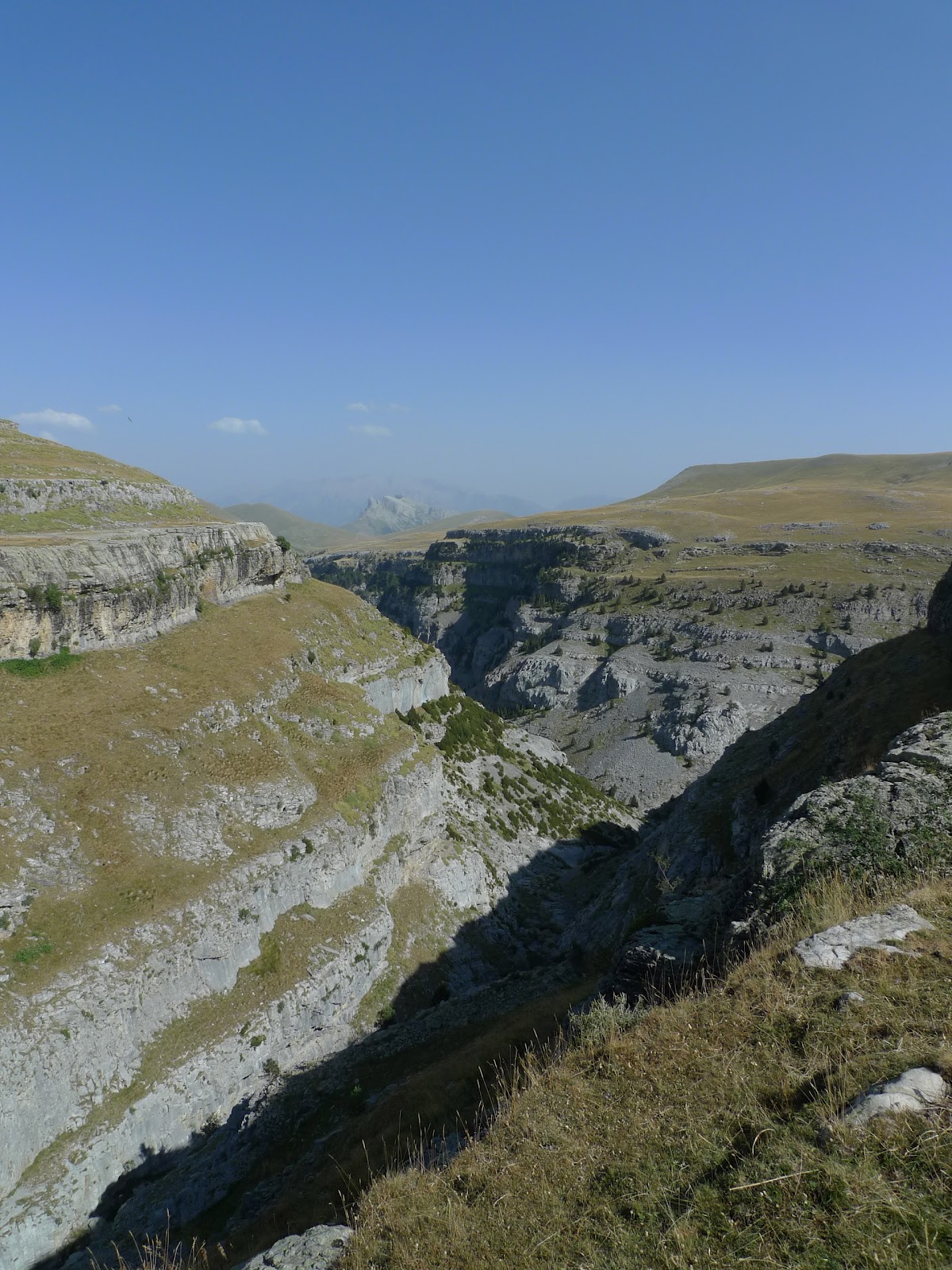
Then I turned a corner and the path revealed the vast expanse of nature before me. I was called back into the present, from the desert of my mind to the scene of indescribable splendor, mountain ranges as far as the eye could see, scaling the sky so blue, while dramatic cliff edges dove into earth’s deep canyon crevices.

There was the now. Beautiful. Infinite. I was shaken from the misidentifications of my mind. I felt this place. I felt it in my bones and in my marrow. I felt it in my mind and in my heart. I felt that this was who and what I really was.

It was like nature’s confirmation that I wasn’t my thoughts, I wasn’t my story (erm, stories, plural), I wasn’t my body. That in essence I was one with the divine, as wondrous and full as the landscape. And this recognition had brought me back into the present path.

This is when the walking meditation started for me. I had arrived at the party, or the process. And now I could take part in the journey. My thoughts disappeared then as I focused on the actual act of walking, of being, of participating in the now.  And that made all the difference.

Having arrived, however, didn’t make the mountain path easy. The path was rarely straight. It went up and down. We edged dangerous cliff-sides. Being afraid of heights, this was a real issue for me.

It took time. It seemed unnecessarily long as we zig-zaged up and down the mountains, yet this was the easiest way. The path was ever changing because that is its nature. I could not change this. But I could be aware of it. As the path changed, so did I, the walker.

Each path is potentially full of obstacles: uphill, downhill, hard rocks, soft unstable ground. That’s how life is. But the obstacles are also opportunities for the great walker: tough gradients cultivate stamina, unstable ground teaches balance, boulders to scale inspire courage.

My focus wasn’t perfect the entire afternoon, either. The view awed, distracted as well as instructed. When I looked only at the path, I missed the rest of the world in front of me. When I looked only at the scenery, I lost the actual path and nearly tripped on rocks before me. There was a need for balanced attention, even perspective to the path and the world beyond.

At the end of this epic walk, I felt—other than great relief at my legs having survived a total of 7 hours of walking—greatly inspired to have taken part in such a yoga practice. This is the yoga of action, of learning from everyday things, of learning to sanctify the most pedestrian of actions.

I had learned a lot on that day. And continue to do so as I constantly steer my wandering mind back to the here and now, applying the lessons of attentiveness in my day-to-day actions. 

I'll be honest, it's not been easy these weeks, continuing to walk the path of the everyday, which I think can be more treacherous than the mountains. But I continue to hold on to that feeling of sublime wholeness that I experienced in the Spanish Pyranees, especially during these times which seem designed to challenge my sense of self. Knowing that one day, I won’t need to recall the scene to feel total and utter fullness. But for now I continue to practice the act of being, which is in itself yoga of action and an act of love.

the rock

Monte Perdido, or "Lost Mountain" in the Spanish Pyranees, part-inspiration for this poem.


The rock


My heart,
this lost mountain
are the same, though
they may not look it.

Porous limestone deposits
leak water. No matter
how much it rains,
no matter how
much snowfall
melts from the peaks,
it cannot hold the
heavenly deluge.

All flow downward
towards the canyon
where all sorts of life
drink their fill, though
the heights are always
thirsty, calcareous throats
dry and chalky.

Topography varies
dramatically:
smooth and curvaceous.
Life is delicate up here,
minute flora, small
but singular, so unlike
their sizable counterparts,
carpet the landscape.
It is also rough and jagged,
terrain so temperamental,
loose bits make for unsafe
footing, though its core
is wholly solid.

Yet, it is not as hard
as it appears. It is also
soft, organic, malleable. 
Time has made its marks,
etched itself into mineral
tablets, life and its
perpetual alphabet:
the history of the world,
according to the mountain.

Deeply rooted, it endures.
It changes. Adapts.
It ages slowly.
Little by little scraped at
with elemental fingertips.
Molded by earth’s deep fires
and rumbling stomachs,
sculpted by changing winds,
from deep freezes to watery
graves that chip, chip, chip
away at it. Nature is an
unkind lover; sweet caresses
scar the mountain’s face,
but not its essence.

It is called “lost”
Because, on occasion,
it goes missing,
because it appears and
disappears from
different vantage points,
from this angle and
that distance.
Still, it does not move,
it is true, it does not
go anywhere.

Rock on which my love is built,
living a long, long time,
but not lasting forever.


--K. Castillo

Thursday, September 20, 2012

yoga, love and marriage


It’s been an interesting journey recently. As usual, filled with a variety of themes. Love and yoga, of course, are constants, but also the idea of marriage. Though each have their particular connotations, they all mean love, they all mean union. Three similar strands woven into my summer tangle.      

For me, it started with an innocent thought after a long separation from the beloved. One that I might have easily kept locked securely in my head, but instead shared quite freely, without inhibition. How at that moment I had wanted to say the words that I had hoped to one day hear from someone that I loved and esteemed, with whom "as long as we both shall live" might not seem like much time at all. Though I hadn't meant to propose, the idea had captured us both. 

The glow of possibility lasted for about a week. That's when a combination of reality and fear set in, causing the entire relationship to scale back into the shadows of undefinability. And though that saddened me, I have to admit that it also appealed to the part of me that is dead-scared of "marriage" and its evil twin "separation."

Because I must love torturing myself, I decided to read Elizabeth Gilbert’s follow-up to her best selling “Eat Pray Love"--which  I reread last summer just as I was going through my own heart-breaking (and as it turns out, heart changing/mending) drama. I obviously have an affinity for good ole Liz!

In “Committed,” the obsessive compulsive (but charmingly so!) writer talks herself into marrying her partner Philippe, who is abruptly ejected from the Unites States, her home country. Since Philippe is Brazilian and the US Immigration is more pragmatic then romantic, Philippe was deported after too many extended stays. In order to continue co-habitating in the US, the couple decide to get married--a horrifying thought for two survivors of tragic divorces from their first marriages.

Gilbert delves into how marriage is viewed in different cultures. How the institution has performed certain functions throughout history, from practical day to day survival, to the fiscal, to community-building. How the expectation of happiness from marriage is relatively new to the scene. How there is power embedded in the act of marriage. How there has been a fight as to who might control this power, from the outlaw of slave marriages to the more recent issue of gay marriages in the US. She makes a pretty good argument on why marriage is an act of great subversiveness, one I liked greatly and one which she favors in the end.


Then I arrived in England just in time to celebrate the ruby wedding anniversary of my friend's parents. The precious red gem is a symbol of great achievement, which suits 40 years of matrimony. It was a low key event, a handful of friends, a lovely meal at a well-appointed local pub, and then champagne, tea and cake at home. The entire day was charming. The sun had come out, the first really nice day since I'd landed. Before lunch, I watched this beautiful older couple excitedly open all their greeting cards, for 40 years inspires many well-wishers, and then give to each other some thoughtfully picked presents: ruby jewelry, a painting admired at an exhibition, a handmade commemorative plate topped with stem ginger chocolate. After lunch, I watched the two cut--in a similar fashion as their wedding day, which was ensured by the comedic best man who made certain all appropriate customs for a ruby anniv were properly observed--into the most moist and drinkable homemade fruit cake, topped with a ceramic groom dipping his bride, a decorative piece that they shopped for together.

For someone like myself, whose parents divorced when I was young, seeing all this is like receiving a soothing, warm balm. It's one thing to contemplate marriage, another thing completely to see it last a lifetime.

Dani and Kalyani's "altar."

Just this last weekend, my new friends Dani and Kalyani got married. Their altar: the dramatic landscape of Ordesa and Monte Perdido National Park in the Spanish Pyranees. Their witnesses: a hundred twenty or so of their friends and family, as well as Mother Nature herself. Theirs is a union steeped in yoga. They met in India just this spring, noticing each other singing to the Devine Mother at the temple at the Sivandanda Ashram in Kerala. They are now, combining dreams, building and running Casa Cuadrau, a beautiful new retreat center in the Village of Vio.


For me, the timing of their meeting is perfect. There was Dani, half a decade, building a house—a foundation for a dream and a life’s calling—which was finally nearly ready. There was Kalyani, at a crossroad, leaving Toronto, pondering her return to Mexico with a desire to start her own yoga project. 

This is what I believe: the goddess, in her infinite wisdom, drew them both towards each other. Both had the intention of sharing deeply. Dani had built a house. But together, Kalyani and Dani will build a home. Together, they bring balance. The masculine and the feminine, shiva and shakti, manifest power and infinite creative potential. Their energies will compliment each other. Their mutual love for yoga and their dedication to share from the heart will light the home fire. With their warmth and light, Casa Cuadrau will grow, and so, I suspect, will they.

All these instances seem intertwined with my own love story this season. There are two story lines, actually: loving myself and loving another, which also intersect/collide accordingly. 

When I was in Madrid last week, I recalled my last trip to the old Spanish city, almost a year and a half ago. I was walking down one of the romantic little side streets of La Latina, telling a friend, who I was swiftly falling in love with, how I didn't have any role models when it came to married couples, how I was determined to be my own role model. And then, caught up in the moment, we kissed.  

I wonder now what kind of a role model I've made since then. Though unmarried, I have certainly welcomed love. I've chased it down. I've given it freely. I've rejoiced at receiving it. I have mourned the moments when it felt as if it were being taken away. I have, on occasion, lost myself in the other, a very very bad habit, I know. I have had expectations. I have been fearful. I have been grasping.

I grew up believing in fairy tales, that there was a charming prince around the corner waiting to save the distressed damsel. When I was older, I began to be fascinated by the concept of soul mates. I was enchanted by creation myths that illustrated the separation of two, the division of lovers, destined to search for one another. All of which reinforced this idea that to feel whole, you had to be in love.

At some point in my adulthood, I gave up on these ideals. In fact, I think I'd given up on love completely. But that day in Madrid and many other days afterwards have changed that.

Over the last couple of years, however, what keeps on coming up for me is that I need to rescue myself. I need to recognize the soul mate deep within. That wholeness is inherent in me, as with everyone. Again, that I need to be my own role model. Concepts that seem so clear and yet seem so easy to forget at the most crucial times. I wholeheartedly believe that if I can keep that self-love steady, then the love for the other will become more fluid, more seamless. And if there is no one particular soul to pour such a river of love into, all is still well.

A couple of weeks ago, Kalyani was telling me about the vows she and Dani plan to share. She explained that she wanted to express how her happiness didn't depend on Dani, nor his on her. Instead, they wanted to share each other's happiness, which was already full to begin with. I guess I feel pretty lucky, the universe seems to once again have my back, sending me role models when I falter at being my own.

For me, this has been this season's yoga, filled with the challenges of connection and the gifts of love. No matter what, it is still love. Love teaches. Love connects. Love lives in all of us.


Friday, September 14, 2012

casa cuadrau, a special kind of bicycle


Casa Cuadrau, approaching the Village of Vio.

Casa Cadrau
When I first arrived at Vio, a small (and small is an overstatement here) village nestled within the Ordesa and Monte Perdido National Park, my jaw dropped. The Valley of Vio is a throwback to another era, and its surrounding landscape, the majestic mountains and canyons of the Spanish Pyranees, inspires wonder.  

And the awe of first arriving continued in the day-to-day at Casa Cuadrau, a retreat center conceptualized and manifested by Daniel Benito Po, who fell in love with the beauty of the area nearly a decade ago. The lovely retreat center, which is run by Dani and his fiancé (very soon to be wife) Kalyani, opened its doors just four weeks ago.

And as the two planned their wedding, they simultaneously took part in the two one-week retreats that I also taught and participated in, as well putting together the countless finishing touches on the house (with the help of some beautiful souls) that has taken 5 years of Dani’s time, patience, and love. 

Ultimately, no words can truly express how special this place really is, for it is at once a gateway to both the old and the new: a retreat center built for inner exploration and transformation, evident by those who are drawn here. As a writer, however, I must give the job of trying to express in words this very special place, one that is best experienced, a decent try.


The Bicycle

Dani, on the soon to be terrace of Casa Cuadrau.
We shouldn’t just dare to dream, we should dare to make each dream, however crazy, a reality.

In Satsang, Dani shares a funny story from a very sad book, Pirineos Montes Tristes or “Sad Pyrenees Mountains”. The title alone says a lot about this region of Aragon.

Life was hard in the Spanish Pyrenees, even in the 20th century, Dani explains, people were poor and winters were cold. The village men either took their sheep down the valley for the entire winter or crossed over La Braca de Rodin on foot—three days trek from Vio—to the sunnier more prosperous French Pyranees, where they worked to bring back money—and something French made.

Wall clocks, which were totally novel in these remote parts, became a staple piece of utilitarian decoration in the homes of men who bravely crossed over to France. Fine proof of the work abroad. The mechanisms and pulleys, precious miniature cargo, crossed on men’s backs as they walked across the snow pass between the Spanish and French Pyrenees. Houses for the clocks were then hand-made in Vio with local materials before it could be proudly hung on the wall.

These timepieces were a good buy. The parts were light and easy to carry. They had real purpose. And they displayed French style and ingenuity.

The bicycle, then, was an unlikely purchase by a villager of Vio. It was an unquenchable fascination, so ill fitting for a place with no roads, only rocks and sheep. He struggled with the idea: the expense of it (an entire winter’s wages, a great deal more than clock parts) and, well, the logistics of transporting an entire bicycle across difficult wintry passage. Still he couldn’t get it out of his mind. All he could think about, dream about was a bicycle.

Until, one day, he just did it. Returned to Vio with, of all things, a bicycle. Somehow managed to carry the unwieldy thing across the steep snow-filled mountain passes. Everyone came to see it. To marvel at him demonstrating how the machine worked in his living room.

He was surely talked about. Even laughed at for his lack of practicality, for how he carried the bicycle across the steep and snowy mountain pass, for how—in Vio—he pushed and pulled on his bicycle in terrain so unyielding, how he walked, not rode, the bicycle alongside his furry keep.

The way Dani reads it, laughing out the words as he describes this man’s passion for the novel invention that represented the idea of France, which itself undoubtedly epitomized a richer, more colorful, more creative, more ingenuous way of living for one so used to humbler ways of life, so untouched by change or innovation, I am reminded that Casa Cuadrau is Dani’s bicycle.

I sit here, now, privileged enough to be a beneficiary of Dani’s crazy dream. Privileged because there’s a roof over my head and a wonderfully equipped kitchen, in which gifted Karma yogis produce nutritiously divine food, and a peaceful yoga shala on the top floor from whose windows the landscape quietly and majestically reveals itself.

When this dream began, Casa Cuadrau, originally erected 1515, was in ruins, leftovers of a house forgotten by time. It was in 2006 that Dani, who had been searching for property to buy in Vio for two years, first saw the for-sale sign.  Already he had a vision in mind.

Casa Cuadrau continues to be a work in progress.
And beautifully so...
Slowly, Dani breathed life into the old structure. It took five years, the sale of a Zaragoza apartment he inherited, the great opposition from his father who thought he was crazy, many cold winters (the summers are short in these parts, I’ve been told) sleeping in a drafty storehouse with all his clothes layered on, huddling tightly against a small heater, practicing yogasana restricted by his padded layers and by uneven floorboards. It’s taken much of his personal resources and a lot of volunteer work in form of karma yoga to rehabilitate the house using traditional architecture and materials, preserving the beauty of the structure and revitalizing it for its new use as a retreat center, a place for self-exploration, through the nature that surrounds this valley, through the art that it inspires and through whole-hearted yoga practice.

And so like a phoenix from the ashes, Casa Cuadrau returned to life. A bicycle of a very special order, bringing young blood into Vio, at first to help take part in building the dream, and now to help make the dream come to life.

Some might say that Vio has not changed much since the arrival of the first bicycle. The village is still remote. The Spanish Pyrenees continue to be magical, and mysterious, and the weather, unpredictable. Presently, there are only about 6 residents that live in the village year-round.

But life here nowadays is not like it was fifty years ago. The advent of electricity and running water has returned some villagers to their home. New ones have come to rebuild—and they come with new dreams, new ideas. Dani and Casa Cuadrau represent not just a revival of the old village, but also hope for its future. It represents a new way of living, and not just here, but everywhere.

I can’t help but imagine how the old villager might approve of Dani’s “bicycle,” how he might nod approvingly at the resurrection of the old house, how he might like to examine its new features, how he might like to try a yoga class or sit for meditation, sample some raw desert or join the kirtan (devotional singing). He would be pleased to see how Dani had turned something old into something incredibly innovative, that the wheels on Casa Cuadrau were really turning, moving—“moving” in every sense of the word, for this is a place of karma, of action (how else did it get built!), it’s a place for shifting and transformation, it’s a place for people to mix and come together, it’s a place that inspires and is inspired.  

Monday, August 13, 2012

to the womb and back

We can cast pretty long shadows...

I've been thinking a lot about the conflict between most children and parents: the endless struggle, which appears to get more complex as time wears on, from infancy to adulthood, and yet seems quite the same as it ever always was.

I've been told that we actually choose the parents to whom we are born to. That this is somehow part of our--sick and twisted as it sometimes seems--karma. This choice, and the lessons embedded in the relationship we have with our family, is crucial to our education, to truly learning who we are.

That this choice was made by me is, kind of, well...comforting. I am, it turns out, a willing participant in what sometimes feels like totally random luck of the draw.

Here's the but: I've stopped believing in dumb luck. Over the last couple of years, my faith in the way the universe works has been greatly buoyed. I believe there is a reason for everything. Yes, even the tough stuff.

And it's great to feel that there is a point to it all, that there is some great purpose to what at times feels like madness. This is yet another gift, one beloved friend would most definitely say, that comes in unusual wrapping.

Recently, in an attempt to "unwrap" this present, this gift of a complex relationship I have with my mother (this is not to say my relationship with my father is much less complicated--but he seems to have figured greatly in last year's grueling discoveries and is thus less prominent now), I traveled to my most unusual destination yet on this trip. I went back to the womb with the help of my friend Kumar, from Mumuksha in Mysore, who is here now in England to do some healing work via transomatic dialogue therapy.

Ok, at this point, some of you reading this might be tempted to roll the eyes, sigh in thinly veiled bemusement at me going all new-age-y. In truth, even I want to sometimes react like this towards myself, give myself a side-glance and an "Ohhhh, really?" 

In a recent conversation, one of my best college friends, who also knows my mother well, suggested I see a therapist to talk out my mommy issues. This too elicits a similar response from me. I can't help it. It's a bit of a reflex. I guess I am from a similar stock as my mother. If you can't grin and bear it in the end, then go figure it out quietly by yourself. Hmmm, perhaps the root of my problems?

Whatever the root, I do recognize that there is only one real problem, one that takes lifetimes to figure out, it takes many births, many parents and a whole lot of varied experiences, some good and some bad. It takes discernment of mind, openness of heart, strength and determination to dig, to uncover layers, to excavate all the blockages that keeps us from the true treasure. We need all the help that we can find, from friends, from loved ones, from therapists and healers, conventional or otherwise. And as for the challenges that arise to test us, they are here to help us too. These presents-in-disguise are obstacles in the darkness. But they are also clues. And as I fumble around the dark room of my soul, these objects give me some idea of my true shape and form, who I am and who I am not.

So here I am, unrooting, unwrapping, traveling unknown distances, pushing boundaries, bumping my knees on obstructions that seem so haphazardly strewn before me--though they are really guiding me down this dimly lit path, where I continue to feel for that magic light switch, so that I might shine, so that I might see.


Thursday, August 2, 2012

uphill battle

A good fit: a prayer for the journey on-going.
Unfortunately, don't have any pics of the magnificent ride.


Pickering, Yorkshire, Great Britain


I like a good bike ride. And by "good" I mean slow and easy, on relatively flat surfaces. A friend back in Boracay would always overtake me on his bike and marvel out loud that it was a miracle I didn't just fall over sideways, I was going so slow.
That's usually how I roll. Smooth. Easy. With turtle-like-stealth.

But not yesterday, as I followed my friend into the forest trails in Yorkshire. We were steadily going uphill. He on the biggest cog. Me, trying to keep up, vacillating between the three, always ending up on 1st each time the heat started to burn at my thighs, which was pretty often.

It seemed an eternity going uphill (mmm, closer to 15 minutes) when I started to think that consenting to this bike ride was a bad idea. I should have stayed indoors. Where it was warm, where I would be sitting, legs happily static. And did I really agree to going off-road into the forest on a road bicycle? What in the world was I thinking!

At some point--as I was huffing and puffing quite undignified-like--I thought, I can still turn back. It was one long stretch back to my friend's house. I was sure I could easily find my way. But this would require some serious pedal power to actually overtake my friend whose legs appeared--at least from my vantage point, with dust and distance between us--to be made of steal. So, instead, I followed on.

Off the road, up we went into the woods, which was, at the super slow motion speed that I was going, sublimely serene. I was struck with this external peacefulness, which felt wild and foreign but also very calm, mostly because it was a stark contrast with what felt like a raging battle within.

My heart was thumping wildly, each beat reverberating in my head. Each sharp slope upwards seemed to push me to some unknown limit. The struggle up the hill seemed to have given rise to loud, mutinous demons within. My demons. Old nemeses. Old so-called friends, pulling me down from all sorts of heights. "What was I doing?" they shouted in my inner-ear. "What was I trying to prove?" "I'm so obviously not good enough."

At some point, it got so bad I had to stop, pull-over, and have a good whimper. By then, I was in the middle of nowhere, my friend's dust had ceased to be visible. It was already late in the afternoon. And it was not a good time to have a total emotional breakdown.

So I inhaled and exhaled and pedaled. Albeit slowly, up the mountain. My friend came back down to meet me, by then quite close to the top. And we made our descent together. From there it was downhill. Also not smooth, on such rocky terrain, but downhill nonetheless. In fact, the entire way back--the same road we came up--was downhill, which made me realize that the entire first half was an uphill battle.

Life is a journey. There are ups and there are downs. The heights we have to sometimes climb seem insurmountable, impossible even. We are challenged. We are often pulled down by these challenges. But if we keep on, we find that it does get easier.

My body, heart, mind moaned and groaned up the forest trail. There was a riot in my head. And yet, slowly, inch by painful inch, I did manage. Though most of the pain, I realize now, was in my head. I got to the top of that blasted--and stunningly beautiful-- mountain. And the freedom of the descent, the exhilaration that came as I sped swiftly down the rocky pathway quieted the din of internal doubts and demons.

It was just me, the bike, and the winding road down.

And, actually, I am looking forward to going back. It won't be much easier, but at least I know I can do it. I can manage the tough ascent. And I'll enjoy the ride, the entire ride, both the up as well as the down.